Module 1 / Lesson 1.4
Definition of Existential Risk
Lesson guide
- Learning: Read and understand the definitions of existential risk and global catastrophic risk below.
- Reflection: Reflect on a risk you take in your daily life (e.g., driving, crossing the street, investing). How does your perception of that risk differ from a friend's? Are you more risk-averse or risk-tolerant in that situation?
Now that we've covered the basics of risk and risk perception, we turn to existential risks (x-risks); rare, high-impact events that could permanently curtail humanity’s potential or end civilization entirely.
What is an Existential Risk?
Philosopher Toby Ord, in his book The Precipice: Existential Risk and the Future of Humanity, provides a precise definition. He defines an existential risk as:
"a risk that threatens the destruction of humanity’s longterm potential." (Ord, 2020, p. 9)
We will discuss Ord's full taxonomy of existential risks in more detail in Lesson 4.3.
Recall from Lesson 1.1 that we described risks by their frequency, severity, and scope. An existential risk has two key features:
- Severity: The potential to cause irreversible, permanent damage or human extinction.
- Scope: Global, affects all of humanity, not just a region or group.
Global Catastrophic Risks (GCRs)
Global Catastrophic Risks (GCRs) are a broader class of threats that could harm or kill a large portion of the global population or cause massive social collapse, but may not necessarily end civilization definitively.
How are Existential Risks Different?
While people may disagree about how likely existential risks are, these are defined by their lasting, worldwide consequences. Unlike ordinary risks, there’s no “bouncing back” if an x-risk goes wrong. Managing them requires global cooperation and action.
Expanded Definitions & Context
Existential Risk:
- “One where an adverse outcome would either annihilate Earth-originating intelligent life or permanently and drastically curtail its potential.” - Toby Ord, The Precipice (2020), p.23 An existential event is an event with this scope and severity; an existential risk is the probability of such an event.
- Severity and scope: Existential risks combine extreme severity (like extinction or permanent global tyranny) and universal scope (all people, or all future generations).
Global Catastrophic Risk (GCR):
- A global-scale disaster causing unprecedented harm and undermining basic human survival or prosperity for much of the world.
- Severity and scope: GCRs have extreme severity (e.g., death) and very broad scope (e.g., millions of people across much of the planet), but unlike an existential risk, they don't need to affect literally everyone or involve severity as bad as death.
- Not all GCRs are existential: e.g., a nuclear event that kills 1 billion is a GCR, but if humanity can rebuild, it’s not existential. All existential risks are GCRs, but not all GCRs are existential risks.
Non‑Existential Risk:
- Most risks we experience are neither existential risks nor global catastrophic risks, as they have far smaller harms and/or much more limited scope. Even extremely bad outcomes would fall short of either a GCR or an existential risk if they had a more local scope (limited to one region or country) or lower severity.
- Most real-life and personal risks are not existential risks: e.g., car crashes, theft, disease, regional disasters.
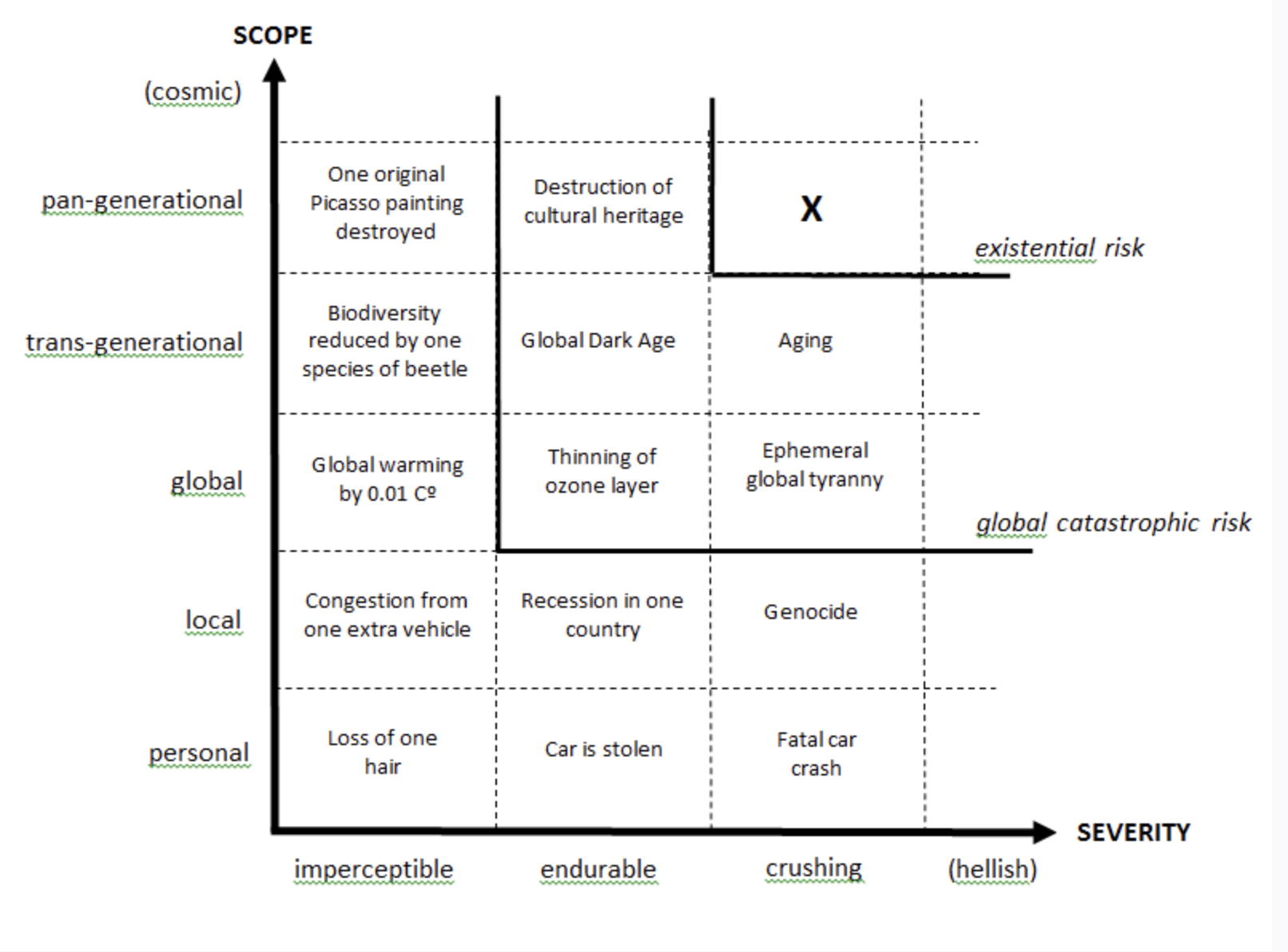
Source: Bostrom, Nick. “Existential Risk Prevention as Global Priority.” Global Policy 4, no. 1 (2013) - https://existential-risk.com/concept
Comparing Risk Types: Real-World Examples
| Example | Severity | Scope | Risk Type | Why? |
|---|---|---|---|---|
| Bicycle theft | Small | Individual | Non-Existential | Limited severity and scope. No impact past one person; recoverable. |
| Dorm fire (single building) | High (for those affected) | Local | Non-Existential | High severity but only local scope. Tragic for those affected, but most are unaffected. |
| Nuclear attack on one city | Extreme (millions die) | Local/Regional | Non-Existential | Extreme severity but geographically limited scope, but civilization can recover and/or continues. |
| Full-scale nuclear war (global effects) | Maximum (billions die; possible extinction) | Global | Existential and/or GCR | Extreme severity and universal scope. Potentially civilization-ending. |
| Superintelligent AI destruction | Irreversible | Global/All generations | Existential (and GCR) | Extreme severity and universal scope. civilization-ending; no rebuilding possible. |
| Major hurricane in one country | High | Regional | Non-Existential | National disaster, but normal life and recovery resume elsewhere. |
| Climate change runaway/mass extinction | Irreversible/potentially total | Global/Multigenerational | GCR | High severity and universal scope. Fundamentally alters life for everyone. |
| Pandemic flu/ COVID or less | High | Global | GCR (not existential) | Extreme severity and broad but not universal scope. Millions may die, but civilization continues. |
Before you move on:
- Most everyday and personal risks are non-existential: recoverable, adaptable, insurable.
- True existential risks are very rare; all GCRs are serious, but not all are existential risks.