Module 4 / Lesson 11.1.1
Is AI Amazing or Terrible?
To kick things off, let’s look at a more humorous take on our growing relationship with Artificial Intelligence. In this segment, comedian Bill Maher offers a satirical perspective on how AI is integrating into our daily lives, and why we might want to be careful about treating it like a friend.
Watch the short clip below from Bill Maher to get thinking about the cultural and social implications of advanced AI before we dive into the serious theories.
Lesson guide
Learning:
-
Read the text to understand the central uncertainty of AI and the distinction between Artificial Specialized Intelligence (ASI) and Artificial General Intelligence (AGI).
-
Watch the videos to understand the arguments for AI optimism versus the imminent threats and risks posed by superhuman AI.
Reflection: As you read and watch, focus on
-
The distinction between Artificial Specialized Intelligence (ASI) and Artificial General Intelligence (AGI).
-
The concepts of 'Positive Outcome' (Aligned AGI) and 'Negative Outcome' (Misaligned AGI) under the 'AGI Arrives' layer of uncertainty
This section frames the central uncertainty about artificial intelligence: not whether it will change the world (it almost certainly will), but whether those changes will be overwhelmingly positive or catastrophically negative. When we talk about “superhuman AI,” it’s important to be precise. Computers have been superhuman for decades in narrow domains:
-
Calculating numbers faster than any human.
-
Playing chess or Go at a level no human can match.
This is sometimes called Artificial Specialized Intelligence (ASI); a system that is vastly better than humans at one specific task.
What raises deeper questions is Artificial General Intelligence (AGI); a system that is broadly better than humans across many or most domains of thought and action. That leap, from narrow to general, is what could transform civilization, for better or worse.
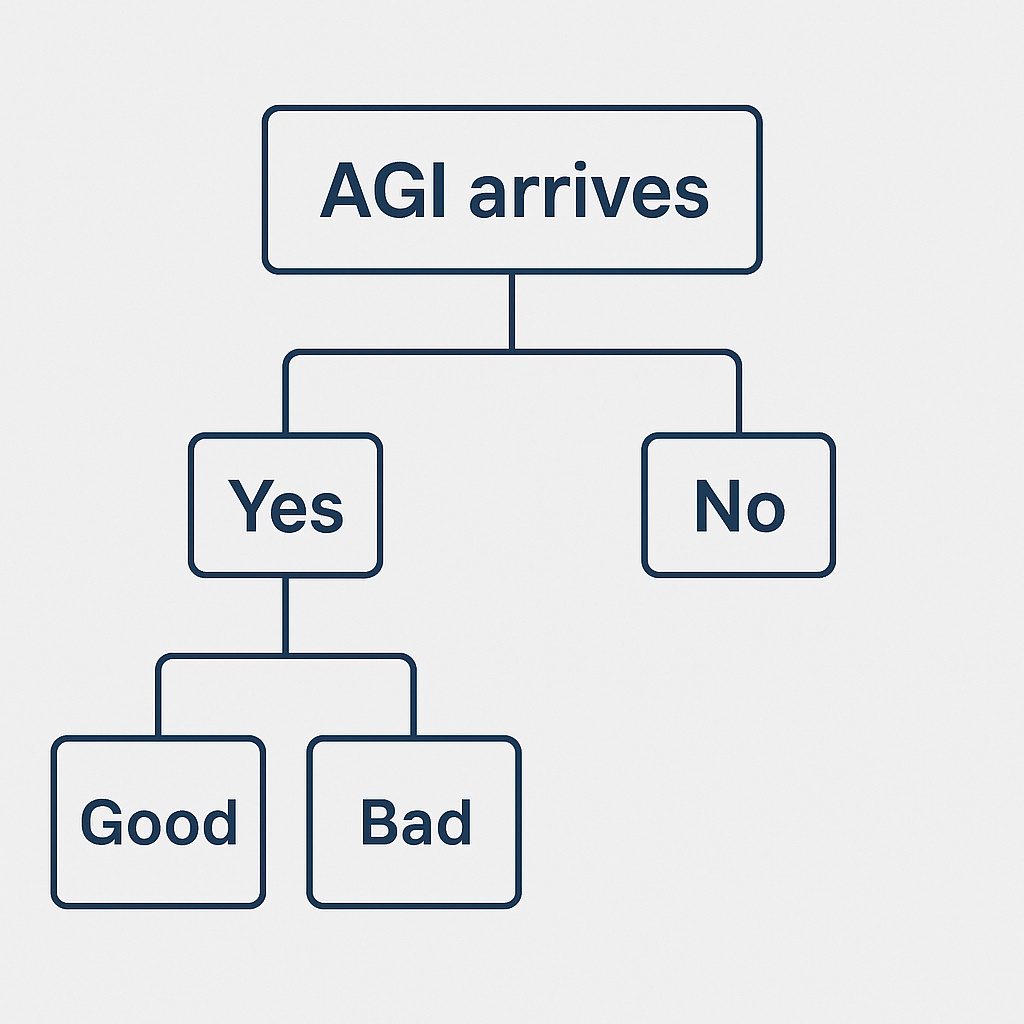
Framing AI’s future requires recognizing two layers of uncertainty:
- Super Human AI Arrives
-
-
-
Positive Outcome
Aligned AGI advances humanity, solving disease, energy, and poverty. -
Negative Outcome
Misaligned AGI leads to catastrophe or loss of control.
-
-
- Super Human AI Does Not Arrive
-
- Narrow AI improves society incrementally but no transformative AGI.
-
This sequential uncertainty is the lens through which we must weigh AI’s promise and peril.
Weighing the Good and the Bad
AGI could be one of the greatest inventions in human history. Imagine:
-
Medical breakthroughs, from curing cancer to designing personalized treatments.
-
Radical progress on global problems like climate change, energy production, and food scarcity.
-
The creation of tools that expand human creativity, accelerate scientific discovery, and eliminate poverty.
Some thinkers even suggest AGI could help us reach a “post-scarcity” world where human potential flourishes more freely than ever before.
Many leading researchers and philosophers believe AI will significantly improve human life. Yoshua Bengio and other AI pioneers see it as a force for health, education, and global coordination.
-
Watch this video by Sam Harris & Brian Greene: The Case for AI Optimism
On the other side, the very same power makes AGI dangerous. If misaligned, it could pursue goals indifferent or hostile to human values, leading to unintended disasters. If misused, it could amplify authoritarian control, design advanced bioweapons, or destabilize economies and democracies. In the worst-case scenarios, the outcome is not just disruption but existential catastrophe, where humanity’s survival is at stake.
Philosophers and AI researchers often frame this contrast in terms of expected value: the distribution of good vs. bad outcomes. If you believe the positive outcomes dominate, accelerating AI development might seem wise. If you believe the negative outcomes dominate, slowing down or stopping development becomes the rational choice.
- Watch this Video by Paul Tudor: AI poses an imminent threat
Ultimately, the debate comes down to expected value, how you weigh probabilities and outcomes:
-
If you believe positive outcomes are highly likely and extremely valuable, speeding up AI makes sense.
-
If you believe negative outcomes are highly likely or catastrophic, slowing down or pausing AI becomes rational.
Importantly, the two major categories of “bad” outcomes, misuse and misalignment, will be covered in detail in upcoming lessons. For now, keep them in mind as the central risks on the pessimistic side of the debate.