Module 3
Welcome to Module 3: Traditional Existential Risks
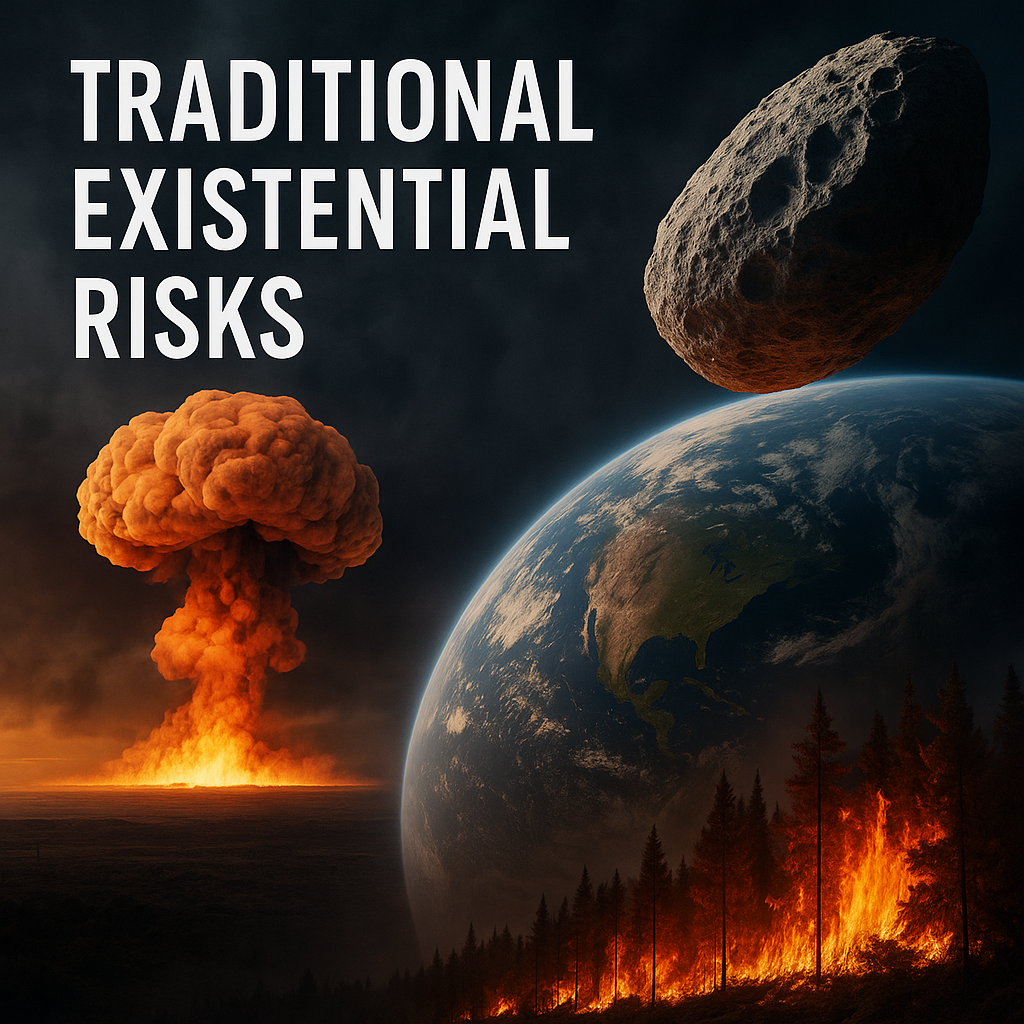
In this module, we examine traditional global catastrophic risks, threats with known historical or scientific precedents. Unlike emerging risks, these have established track records that allow us to compare historical frequency against prospective modeling.
Module Roadmap & Estimated Time
- Lesson 6: Natural Risks Est. 90-120 mins
Asteroids, Comets (7.1), Supervolcanoes (7.2), Total Natural Risk Estimates (7.3), and the Tools of Risk Estimation like Survivorship Bias (7.4).
- Lesson 7: Nuclear War Est. 60-90 mins
History of nuclear development, "Close Calls," and the science of Nuclear Winter.
- Lesson 8: Climate Change Est. 90-120 mins
Identifying sources of uncertainty, extreme warming scenarios, and the difference between global catastrophe and true existential risk.
-
Lesson 9: Pandemic Est. 90-120 minsThis lesson integrates biological, historical, and technological perspectives to help you understand how infectious diseases emerge, spread, and evolve, and how human society adapts in response.
Module Goal: By the end of this module, you should be able to critically analyze traditional existential risks and reflect on how society prepares (or fails to prepare) for threats with established scientific models.
Tip: Pay close attention to how each risk is modeled, and ask yourself: Are we overconfident in what we think we know?
Tip: Pay close attention to how each risk is modeled, and ask yourself: Are we overconfident in what we think we know?