Module 1 / Lesson 2.6
Saving as Risk Management Strategy
- Learning: Read and understand the content material below.
- Reflection: Reflect on your own reasons for saving and situations where having savings could be essential. Understand why saving is an important strategy for managing life’s risks.
- Savings: Setting aside money today to have resources tomorrow.
- The savings you set aside for the future can be used for anticipated future needs (e.g., retirement) and also recovery after potential future losses (e.g., house burns down, car accident, etc.)
- Intertemporal Trade-off: Choosing how much to spend today vs. how much to save for tomorrow.
The Mechanics of Saving
- You care about consumption today (C₁) and tomorrow (C₂).
- If you have W dollars today, you split them for spending (C₁) and saving (S).
- Saved money earns interest, so tomorrow you get to consume S(1 + r) for C₂.(Ex: If the interest rate is 12%, $1 saved today yields $1.12 tomorrow.)
- Saving less now means more for tomorrow, but less for today.
Types of Savings vehicles:
- Bank account
- Money under your pillow
- Buying a home
- Investment or retirement fund
Saving doesn't need to be risk-free like a bank account, housing or stocks are risky forms of saving.
What determines the value of saving?
Interest rate: Higher rates mean more future money for what you give up today. Bank accounts are certain but low, stocks are riskier but potentially higher.
Value of money (Inflation): High inflation erodes the future purchasing power of your saved money.
Need for funds today vs tomorrow: You trade off present comfort for future security, which depends on your life context.
Why Save? Two Main Reasons
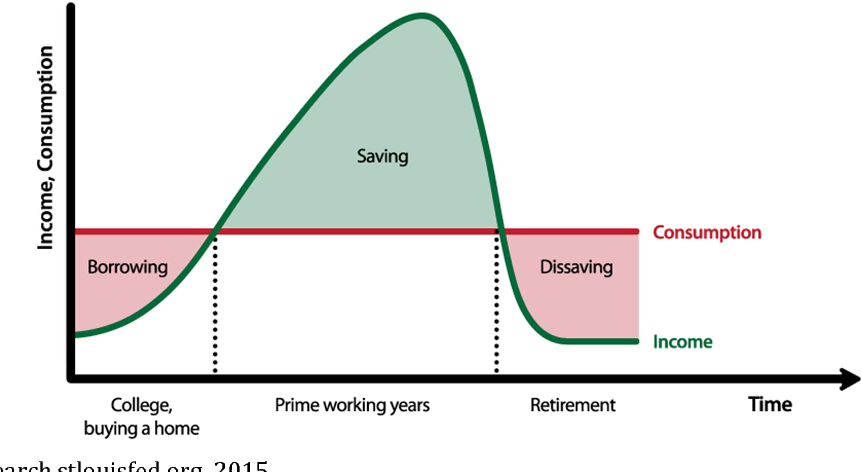
Fig: Life Cycle Savings Graph
Saving is the difference between what you earn and what you spend. People tend to earn more during their working years but want to spend across their entire life. Saving allows you to smooth out your consumption for needs like retirement when income falls to zero. The diagram above shows times in red early and late in life when you might spend more than you earn (as a student borrowing -- negative saving -- racking up student loans and a retiree drawing down savings) and also shows the middle age time in green when you might earn more than you spend to save to either pay down student loan debt or saving for retirement.
- Savings give you the resources to recover from a wide variety of bad things:
- Replace property
- Cover emergencies
- Maintain lifestyle during loss
- If nothing bad happens in the future, you might regret spending less today to be ready for a bad event that never happens.
Examples: Normal vs. Existential (x-Risk) Savings
- Personal/Normal:
- Emergency fund: Money set aside for job loss, emergencies, car repairs.
- Disaster fund: Rebuilding after fires, floods, etc.
- Investment or retirement fund: Can be repurposed to help recover from losses; can serve many future needs.
- Global Catastrophic Risks:
- Svalbard Global Seed Vault: Backup seeds for global crop recovery.
- Data backups: Redundant information for survival in catastrophic failures.
Pros and Cons of Savings as Risk Management
- Cause-neutral flexibility/Multi-purpose protection: One emergency fund covers many risks; you don't have to predict the bad event. Money works for whatever goes wrong or can even be spent on everyday needs.
- Misallocation: If no loss occurs, you consumed less today but received no future benefit.