Module 1 / Lesson 2.2
Insurance as Risk Reduction
Learning guide
- Learning: Continuing from the previous lesson, Learn about insurance choices change when individuals face different levels of risk and loss.
Recap: The Bike Example Without Insurance
Let's begin by recapping our previous example from Lesson 2.1:
- You own a bike that could be stolen, for a loss of L = $96. If your bike is stolen, you have to spend $96 out of your bank account to replace it.
- You have initial wealth W0 = $121 in your bank account.
In the previous lesson, we saw this is a situation with two states (no loss and loss), and we used a two‑state model to describe your bank account balance in this risky situation. After any potential loss and bike replacement, your wealth will either be WNoLoss = W0 = $121 (bike not stolen) or WLoss = W0 − L = $121 − $96 = $25 (bike stolen).
Now we introduce insurance as a tool to manage risk. Recall from Lesson 1.3 that "insurance and risk transfer" is one of the five major categories of risk management strategies. Here, we explore how this category of risk management strategies works.
What is Insurance?
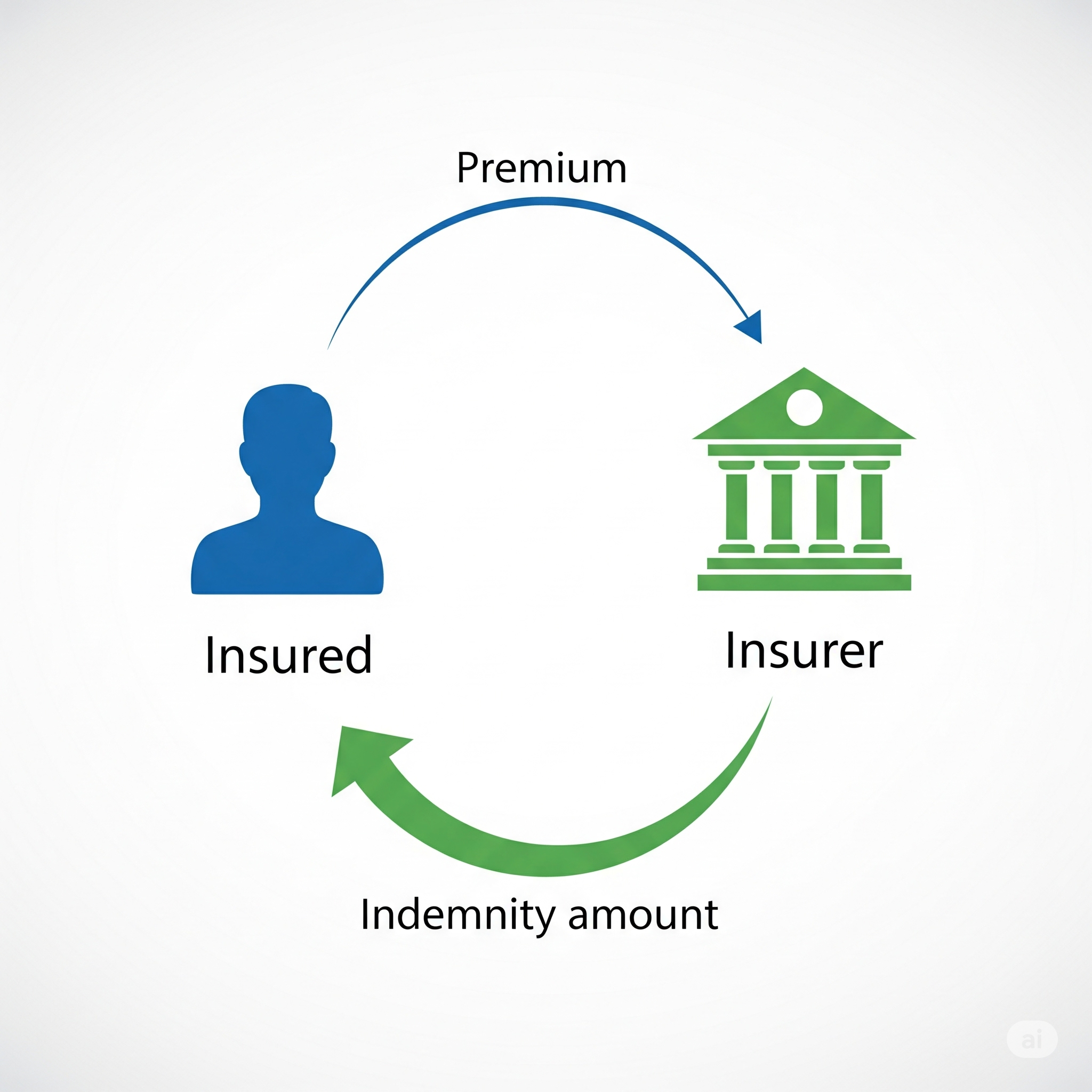
Insurance is a financial contract that transfers risk from an individual (the insured) to an insurance company (the insurer). Let's define the key terms:
Key Insurance Terms:
- Premium (P): The amount you pay to the insurance company for coverage, paid before anyone knows if there will be a loss. (Note, we use upper-case "P" to denote premium, and later we will use lower-case "p" to denote probability. Please keep this in mind.)
- Indemnity (I): The amount the insurance company pays you, if and only if a loss occurs.
- Insured: The person buying insurance protection (you).
- Insurer: The insurance company providing the coverage.
(Note about premiums: the insured does NOT get the premium returned if there is no loss.)
(Timing Note: We ignore other spending/interest between purchase and outcome; we compare wealth only at the time after we learn whether the loss occurred.)
Full insurance means the insurer fully covers the loss, so that I = L. The insured then has the same wealth in the no‑loss and loss states. In contrast, partial insurance provides I < L.
A Full Insurance Example
Consider a specific full insurance product for the bike scenario:
- Premium (P) = $40 (paid regardless of outcome)
- Indemnity (I) = $96 (paid only if the bike is stolen)
If there is only one possible loss state, then an insurance product is described completely by its premium (how much the insurance costs) and indemnity amount (how much the insurance pays in the event of a loss). (If there are more than one loss state, then insurance will have more features like deductibles, co-payments, and upper limits that we ignore here.)
Wealth Flows and Formulas with Insurance
Wealth Flows with Insurance:
- No loss. The insured pays P but receives no indemnity.
- Insured: Wealth decreases by P (here $40).
- Insurer: Wealth increases by P (here $40).
- Loss. The insured pays P and receives I.
- Insured: Wealth increases in the loss state by I − P (here $96 − $40 = $56).
- Insurer: Wealth decreases by I − P (here $56).
KEY POINT: Buying insurance transfers wealth from the no‑loss state to the loss state: you give up P in good times to receive I − P in bad times.
Wealth Formulas with Insurance:
- No Loss: WNoLoss = W0 − P = 121 − 40 = 81
- Loss: WLoss = W0 − L − P + I = 121 − 96 − 40 + 96 = 81
Same wealth in both states ⇒ full insurance.
Visual Comparison: Insurance vs. No Insurance
(This diagram adds the green dot of full insurance to the diagram you saw in Lesson 2.1, where the red dot represents the situation with no insurance.)
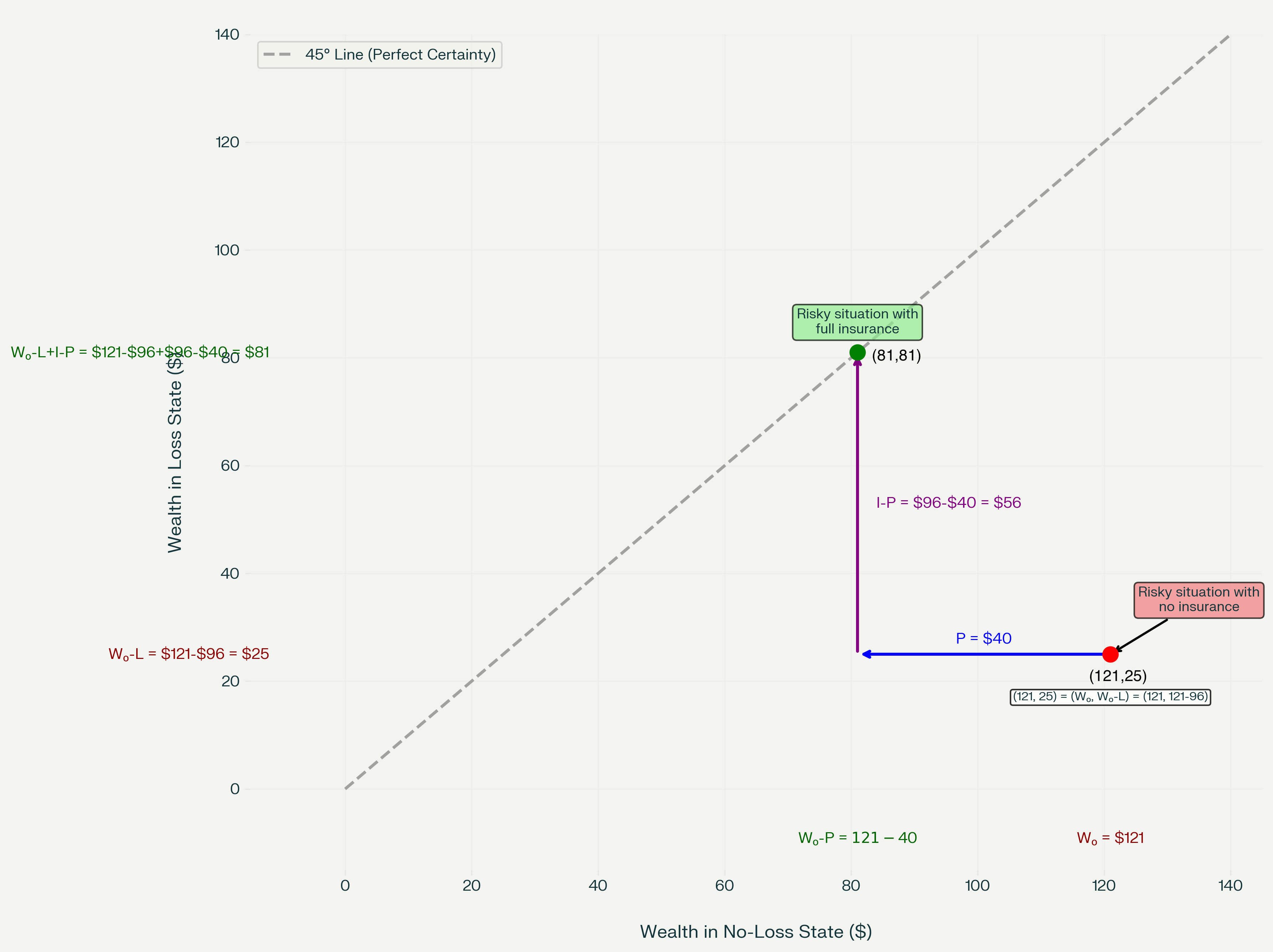
- Blue left arrow: P = 40 (x: 121 → 81)
- Purple up arrow: I − P = 96 − 40 = 56 (y: 25 → 81 at x = 81)
- 45‑degree line: Green point is on the certainty line
Cash Flow Diagrams
Let's visualize exactly when money flows in each scenario:
Summary: How Insurance Works
Insurance moves you closer to the 45‑degree certainty line, smoothing your wealth across different outcomes.
Without insurance:
- No loss: $121 (WNoLoss = W0)
- Loss: $25 (WLoss = W0 − L = 121 − 96)
With full insurance (P = 40, I = 96):
- No loss: $81 (WNoLoss = W0 − P = 121 − 40)
- Loss: $81 (WLoss = W0 − L − P + I = 121 − 96 − 40 + 96)
- Trade‑off: Give up wealth in good times (pay P) to gain in bad times (receive I − P).
- Convergence: Wealth in the two states becomes more similar.
Lesson Video
This short video walks through the mechanics of insurance using the bike example, showing how premiums and indemnities reshape wealth in each state.
Coming Up Next
In this section, we saw that insurance causes people to give up wealth in good (no loss) states to receive more money in bad (loss) states. Why might they want to do this? Next, we examine risk tolerance and expected utility.